
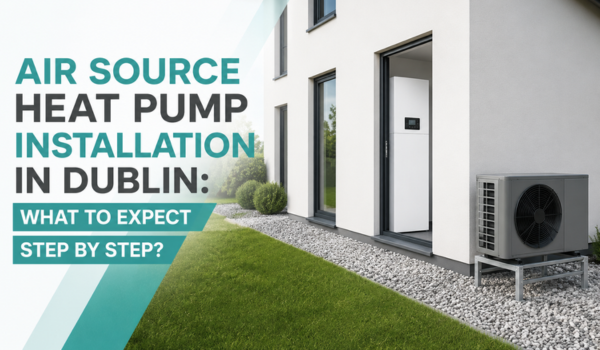
A lot of Dublin homeowners are ditching oil and gas boilers and moving to air source heat pumps. It’s not hard to see why. Heating bills have gone up, fossil fuels aren’t getting any cheaper, and the government is now offering up to €6,500 in SEAI grants to help cover the cost of switching. If you’ve been thinking about it but don’t know what the process looks like, this guide will walk you through it from start to finish.
What Is an Air Source Heat Pump?
An air source heat pump pulls warmth from the outdoor air and uses it to heat your home and hot water. It works even when it’s cold outside – which, let’s be honest, is most of the year in Dublin. Unlike a boiler, it doesn’t burn fuel. It moves heat that is already in the air, which is why it uses far less energy than conventional heating systems.
At Green Energy Homes, we install Viessmann heat pumps. The Vitocal 150-A is one of our most popular models – it carries an A+++ energy rating, runs very quietly, and uses R290 (propane) as a refrigerant with a global warming potential of just 0.02 over 100 years. The Vitocal 222-A is another strong option, offering both heating in winter and cooling in summer through a reversible circuit, with a COP of up to 5.0.
Step 1: Get in Touch and Tell Us About Your Home
Everything starts with a phone call or a visit at Green Energy Homes. You can reach us on 016855575 or come in to talk to the team at our Swords Showroom: Unit F2, Swords Enterprise Park, Drinan, Swords, Co. Dublin, K67 WF72.
All we need from you at this point is your Eircode. If you don’t have one, GPS coordinates do the job. From there, we can usually come back to you with a price fairly quickly. Someone from our team may also ring to ask a few questions about your home – things like the size of the property, what heating system you have now, and how well insulated it is.
Step 2: We Survey Your Property
Before booking in any work, we’ll carry out a full technical and safety survey of your home. This is a really important step, as it tells us exactly what your home needs, and ensures the installation goes smoothly.
During the survey, we’ll assess:
- The size and layout of your home
- Your existing heating setup – radiators, underfloor heating or a combination of both
- The insulation levels of your attic, walls and floors
- The location options for the outdoor unit
- Whether any part of your existing system needs upgrading first
This gives us everything we need to plan the right installation for your home.
Step 3: Applying for the SEAI Grant
The SEAI grant is one of the biggest reasons people are making the switch right now. The Sustainable Energy Authority of Ireland offers up to €6,500 towards an air source heat pump in homes built and occupied before 2011.

You can find the latest grant figures on our SEAI grant Ireland 2026 page. Because Green Energy Homes is fully SEAI-registered, we handle all the grant paperwork on your behalf. You don’t need to deal with the SEAI directly or chase any forms – we do that for you.
Step 4: Picking the Right Heat Pump for Your Home
Once the survey is done and your grant application is in, we look at which model suits your home best.
Homes with underfloor heating get the most out of a heat pump. Underfloor systems run at a low flow temperature of around 30–35°C, and heat pumps work best at those lower temperatures. For homes with older radiators, we sometimes recommend fitting larger ones so the heat pump can run at lower temperatures without losing warmth.
Here’s a look at the Viessmann models we install:
- Vitocal 150-A – A+++ rated, handles flow temperatures up to 70°C even when it’s -10°C outside. The indoor unit is 60% smaller than similar models. Good for older homes being retrofitted.
- Vitocal 151-A – Same as the 150-A but comes with a built-in 190-litre hot water cylinder. A solid choice for homes that use a lot of hot water.
- Vitocal 200-A – Output range of 2.3 to 11.8 kW, A++ to A+++ rated, and built with acoustic design to keep noise down. Made in Germany.
- Vitocal 222-A – Heating and cooling in one unit, COP of up to 5.0, compact monobloc design. Good for homeowners who want to cool the house in summer too.
All models connect to the free ViCare app, so you can control your heating from your phone.
Step 5: Installation Day
Most air source heat pump installations take one to three days.
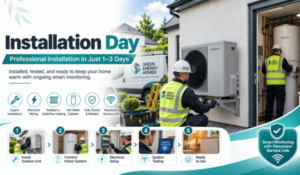
Here’s what happens on the day:
- The outdoor unit goes up on a wall bracket or ground base outside, somewhere with good airflow
- The indoor unit or cylinder is fitted inside – usually in a utility room, hot press, or garage
- Pipes are connected between the indoor and outdoor units
- The system ties into your existing radiators or underfloor heating
- An electrician handles the wiring
- We test everything before we leave to make sure it’s all running correctly
Viessmann’s Service Link feature also means that if anything needs attention after installation, it can be picked up and dealt with quickly.
Step 6: Getting Your Controls Right
Having the right heating controls set up properly makes a real difference to your bills. Heat pumps don’t work the same way as boilers – they run at lower temperatures for longer stretches rather than firing up in short, intense bursts.
After installation, we show you how to use the ViCare app and get your schedule set up so the system runs the way it should. A well-set heat pump costs less to run and keeps your home warmer through the winter.
Is Your Home Ready for a Heat Pump?
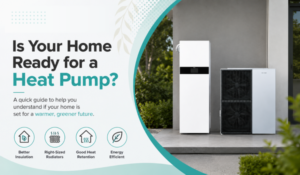
Most Dublin homes can take a heat pump without too much preparation, but a few things affect how well it performs:
- Insulation – The less heat your home loses through the walls and roof, the less the heat pump has to work. If your insulation needs attention, Green Energy Homes can help with attic insulation and external insulation through the same SEAI scheme.
- Radiators – Older, smaller radiators may need to be swapped out for larger ones to work well at lower flow temperatures
- Hot water demand – Higher demand homes are better suited to a model with a built-in cylinder, like the Vitocal 151-A
For new builds, fitting a heat pump from the start is even easier. It helps meet Part L Building Regulations and pairs very well with underfloor heating when laid before the floors go down.
Why Use Green Energy Homes?
Green Energy Homes is a Dublin-based company covering heat pumps, insulation, solar, and more. We’re SEAI-registered, we supply Viessmann equipment, and we handle the grant process for you. Come and see us at our Swords Showroom: Unit F2, Swords Enterprise Park, Drinan, Swords, Co. Dublin, K67 WF72, or give us a ring on 016855575 to get a quote.
Conclusion
Switching to an air source heat pump in Dublin is one of the better home decisions you can make right now. The SEAI grant takes a big chunk off the upfront cost, the technology is reliable, and running costs are lower than oil or gas over time. Whether your home is a new build or an older retrofit job, the team at Green Energy Homes will guide you through every step. Call 016855575 or visit greenenergyhomes.ie to get started.
FAQs
1. How much does air source heat pump installation cost in Dublin?
The cost depends on your home size and the model you go with. SEAI grants of up to €6,500 bring the price down a lot.
2. How long does the installation take?
Most jobs are done in one to three days. It depends on the size of your home and whether any prep work is needed first.
3. Can I get a grant for an air source heat pump in Ireland in 2026?
Yes. The SEAI offers up to €6,500 for homes built before 2011. Full details are on our SEAI grant Ireland 2026 page.
4. Will a heat pump work with my existing radiators?
In many cases yes, but older or smaller radiators may need to be upgraded. Our pre-installation survey checks this so you know before any work starts.
5. Do I need underfloor heating for a heat pump?
No. Underfloor heating gives the best results, but a heat pump works well with the right radiators too.
6. What Viessmann models does Green Energy Homes install?
We install the Vitocal 150-A, 151-A, 200-A, and 222-A. All are A++ or A+++ rated and suited to Irish weather conditions.
7. Does the heat pump also heat my water?
Yes. It covers both space heating and hot water. The Vitocal 151-A has a built-in 190-litre cylinder for homes that use a lot of hot water.
8. How noisy is a heat pump once it’s running?
Viessmann models are very quiet. The Vitocal 200-A uses acoustic design to keep noise levels low – you’ll barely notice it outside.
9. Can I control my heat pump from my phone?
Yes. All Viessmann models connect to the free ViCare app so you can adjust heating, check energy use, and manage hot water from anywhere.
10. How do I get started with Green Energy Homes?
Call 016855575, visit our Swords Showroom at Unit F2, Swords Enterprise Park, Drinan, Swords, Co. Dublin, K67 WF72, or go to for contact and fill in the contact form. We’ll get back to you from there.